|
 |
The Old St Beghian | |
| July 2026 | |||
George Robson (FN 57-64) - Journey Recollections.
“During my seven years as a pupil (1957-1964), I only remember one boy whose family lived in the village. He was a dayboy rather than a boarder. Of course, in the early years of the school I guess all the pupils were thus because Grindal had founded the school to benefit the village of his birth and the immediate surrounds. However, the coming of the railways in the second half of the 19th century made it much more realistic for boys from distant areas of the country to travel to and from firstly the Theological College then the school. The St Bees station had opened in 1849.
Over recent years I have been researching pupils who served their country during the three major wars of the 19th and 20th centuries- the Boer (South African) War, the Great War and World War Two. In almost every case the soldier I was centring on came from a family many miles from St Bees. Examples are: Donald Neilson DSO MC - Lyddington (Rutland), Percy Loft – Bishop Aukland (Co. Durham), John Scott – Wiltshire, A F Stephenson – Liverpool.
And in time, of course, Old Boy branches were set up, some of which still operate.
Whilst a pupil at our school my family home was at Blyth on the Northumberland coast and to travel to St Bees necessitated three stages – firstly a journey of fifteen miles to Newcastle’s Central station, then through the ‘Tyne Gap’ to Carlisle, and finally south to St Bees.
On average there would be eight of us taking over a carriage at Newcastle, although most of us would steal into an adjoining first class compartment only to be chased back by the ticket collector as he did his rounds! Boys will be boys, I guess, so be assured high jinx and even some beer-swilling invariably took place as we travelled.
On the journey to Carlisle we picked up more boys at the various stations we passed through, particularly at Hexham where on average five lads joined us.
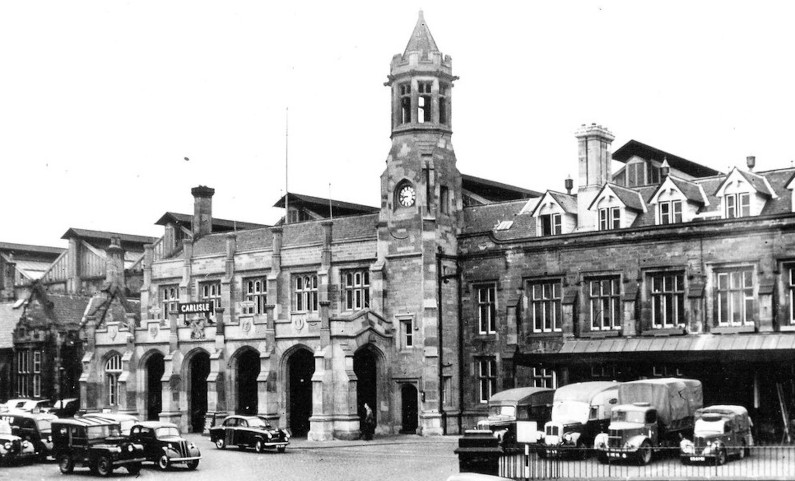
There was inconvenience at Carlisle where we had a wait of two and a half hours before the connection south set off. This gave us the opportunity to look around Carlisle.
I had read about the famous LICKING STONE at Carlisle castle and more than once I went to the castle with a few pals to view it and the rooms Mary Queen of Scots occupied whilst a prisoner here in 1568.
However, other than the licking stone there was something even more important to me in Carlisle. I discovered there was a coin and stamp shop in the main street. I held myself, as I still do, something of a philatelist and numismatist and never missed calling, becoming a familiar customer to the staff. I remember in particular a visit I made in 1958 because there was a five pound orange stamp of 1883 for sale. I had recently had a birthday and, thanks to a wealthy great aunt, I had the funds to purchase the stamp, which I still have proudly framed in a conspicuous place (see picture). I am still amazed that a five pound stamp was thought necessary in 1883, for five pounds were equivalent to six hundred pounds in today’s money. Mind you, most of the stamps were not for postage but as excise duty for tobacco or whiskey.
On arrival at the St Bees’ station, we fanned out to our various houses where our trunks and tuck boxes were awaiting us. I have no recollection at all of how our luggage travelled to and from St Bees – perhaps a reader can report on how this was achieved and how it reached the various houses? And perhaps there are also readers willing to write in with accounts of their own journeys to and from school?”
St Bees Station in the 1960s


Home
The St Beghian Society
St Bees School,
St Bees, Cumbria, CA27 0DS.
Tel: (01946) 828093 Email: osb@stbeesschool.co.uk
Web: www.st-beghian-society.co.uk
